
Rainbow Bay: Coolangatta’s Sheltered Family Beach
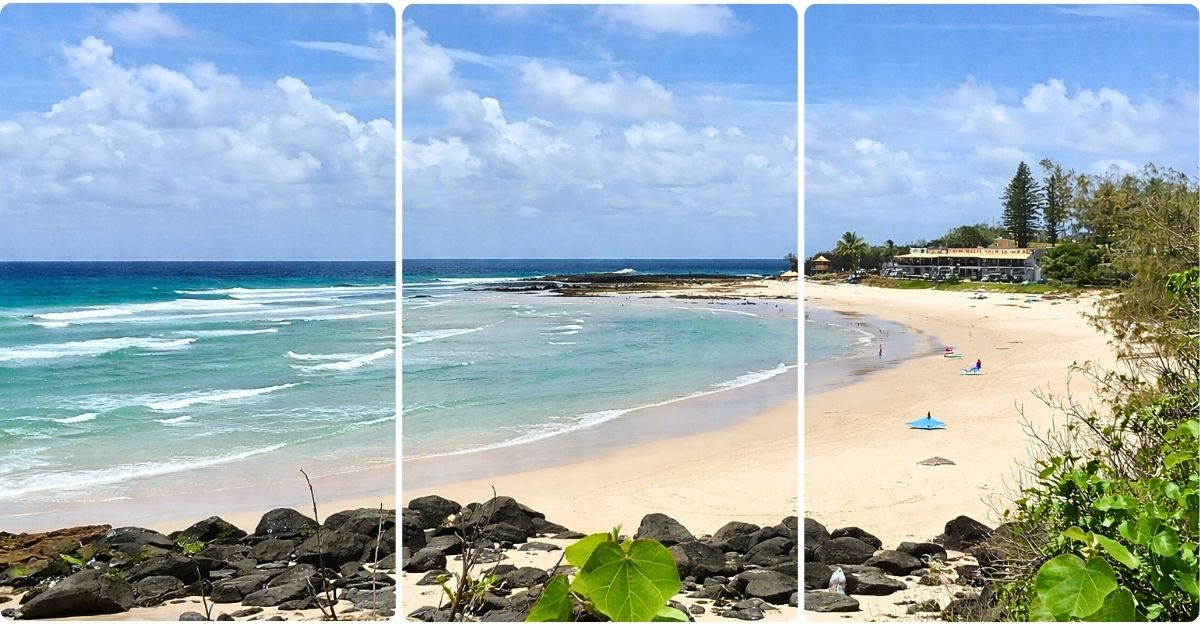
Rainbow Bay sits between Greenmount Beach and Snapper Rocks on Coolangatta’s southern edge, protected by Greenmount Hill from the southern swell. Three hundred metres of north-facing sand and rock pools, backed by Pat Fagan Park. It’s what parents actually mean when they say they want a family beach.
The water here stays calm. Genuinely calm. On still mornings you can watch fish move beneath it, and the rock pools in the shallows keep children entertained for hours. Tree-shaded picnic tables line the foreshore. Toilets and showers are steps from the sand. There’s a three-storey Surf Rescue Tower disguised as a dune buggy in the playground, because somebody understood that kids need more than just swings.
Why Rainbow Bay Works for Families
The sheltered bay means smaller, rolling waves ideal for paddlers and swimmers learning their way in salt water. Surf lessons run from here for families and beginners. The beach patrol season runs September to May, with volunteers and Council lifeguards covering weekends and public holidays during peak months. Outside patrol season, Council lifeguards continue coverage, so swimmers aren’t left unsupervised.
Parents feel confident here. Not because the beach is boring or overly tame, but because the design actually works: shallow entry, clear sightlines across the bay, and trained eyes on the water during busy times. Combine that with the themed playground right on the foreshore (so you watch the kids play while keeping an eye on swimmers), and you understand why locals come back.
One detail worth knowing: no dogs are allowed on Rainbow Bay beach. If you’re bringing the family dog, plan to visit nearby reserves instead.
Getting There and Parking
Street parking lines Marine Parade, though on weekends it fills quickly. The Strand car park sits nearby with three hours free weekdays and two hours on weekends. Buses 700, 760, and 768 run from Broadbeach South. (The G:Link expansion to Coolangatta was cancelled in September 2025, so public transport remains bus-based for now.)
The foreshore is flat and accessible throughout, with accessible parking and facilities available. Ramps connect the car park to the beach.
What’s at the Beach
Pat Fagan Park provides the backbone: shaded picnic tables, BBQ facilities, and that standout playground. It’s designed to feel like a destination, not just a scattered collection of amenities. Toilets and showers sit on-beach. The rock pools on the eastern end reward exploration if you arrive at low tide. Clear water means you can actually see what’s down there.
The beach feels less crowded than its more famous neighbours. Partly geography (it’s a shorter stretch, naturally tucked away), partly word-of-mouth. Stunning water, hardly ever rammed, and you can watch world-class surfers from the lookout at Snapper Rocks just around the corner. That combination doesn’t stay secret long once you find it.
Food and Coffee
Rainbow Bay SLSC runs beachfront dining with views across the bay, a local favourite for weekend breakfast and lunch. Switchfoot operates as a locals’ favourite coffee and food spot in Rainbow Bay itself, serving Bun Coffee alongside food. Little Mali, a casual café, offers acai bowls and vegan options nearby on the Strand. None of these are destination restaurants, but that’s the point: simple, good, and close enough to the sand.
Snapper Rocks and Whale-Watching
Snapper Rocks sits immediately adjacent at the bay’s eastern end. It’s one of the world’s most recognised surf breaks, home to WSL competition events and advanced-only waves. You’ll see surfers paddle from Rainbow Bay across to it, or watch from above via the elevated boardwalk through Apex Park (Snapper Rocks Lookout / Point Danger Viewing Platform). The contrast matters: Rainbow Bay is for families and beginners; Snapper is for professionals. They coexist because the geography allows it.
From May to November, the Point Danger lookout becomes a whale-watching vantage point as humpbacks migrate south. Bring binoculars and patience. You’ll see them move along the coast.
Sunrise and Seasonal Shifts
Rainbow Bay faces north, so sunrise comes quietly, light climbing from the mainland rather than erupting over the water. Autumn and winter bring clearer water and fewer swimmers. Spring and summer draw families and learners. Cyclone Alfred caused erosion in March 2025, but recovery work was underway as of April 2026. Check current conditions before visiting if you’re concerned about beach profile changes.
What Makes It Different
Rainbow Bay isn’t the biggest beach on the Southern Gold Coast. It isn’t the most dramatic or the most social. What it offers is rare: a genuinely sheltered, naturally calm swimming area where children can play safely, parents can relax, and the water stays clear enough to see through. The playground works. The parking is manageable. The food is nearby and decent. The rock pools keep kids busy. The lookout gives you a window into the professional surf world without requiring you to be part of it.
It’s the beach that works without feeling designed to work. That’s worth the trip down to Coolangatta.
Practicalities
Patrol season: September to May (weekends and public holidays). Council lifeguards patrol outside these times.
Facilities: Toilets, showers, accessible parking, picnic tables, BBQ, playground, rock pools.
Dogs: No dogs allowed on the beach.
Accessibility: Flat foreshore with accessible facilities throughout.
Getting there: Buses 700, 760, 768. The Strand car park (3 hrs free weekdays, 2 hrs weekends). Limited street parking on Marine Parade.
Nearby: 100+ Things to Do on the Gold Coast or Top 10 Things to Do on the Southern Gold Coast.