
Mudgeeraba is the suburb the Gold Coast forgot to turn into a beach town. While Burleigh and Broadbeach were being built up around tourism, Mudgeeraba kept its railway-era main street, its saleyards-adjacent showground and its farmers market (believed to be the oldest on the Gold Coast). The trade-off: you are 12km inland from the sand, and Council’s own planning rules keep it that way on purpose.
Mudgeeraba Boundary and Location Map
Mudgeeraba sits in the Gold Coast hinterland foothills, about 12km inland from Burleigh Heads and roughly 20km from Surfers Paradise, the Gold Coast’s tourist and business hub. It borders Robina to the east, Tallai and Worongary to the north and west, and Bonogin and Reedy Creek to the south, with the Pacific Motorway (M1) forming its eastern edge and its own dedicated Mudgeeraba interchange.
Quick Facts
| LGA | City of Gold Coast |
| Postcode | 4213 |
| Population | 14,578 (2021 Census, up 7.0% from 13,624 in 2016; a private industry projection puts 2026 at around 15,600, not an official ABS figure) |
| Growth Rate | +7.0% between 2016 and 2021 Census counts |
| Distance from CBD | ~12km from Burleigh Heads, ~20km from Surfers Paradise, ~76km from Brisbane CBD |
| Character | Nineteenth-century railway village turned hinterland gateway suburb, heritage core protected by Council planning controls |
| Median House Price | $1,340,000, up 10.74% in the 12 months to April 2026 (CoreLogic data via Your Investment Property) |
| Median Unit Price | $927,750, up 18.77% in the 12 months to April 2026 (CoreLogic data via Your Investment Property) |
| Median Rental Price | Around $850 to $1,000 per week for houses in 2026 listings; the 2021 Census recorded a $500 per week median, now well out of date |
| Transport | Robina heavy-rail station on the suburb’s doorstep, Translink bus routes 748, 758 and 759, dedicated M1 interchange, GC Surfer metro-style bus service (Robina to Coolangatta via Burleigh Heads and the Gold Coast Airport) plus a planned Robina to Miami service via Bond University, both part of the state’s Gold Coast Transport Plan with no firm start date published (Dept of Transport and Main Roads, current August 2026) |
| Major Attractions | Mudgeeraba Farmers Markets, Hinterland Regional Park, Mudgeeraba Showground, heritage-listed Wallaby Hotel and Old Post Office, Bell Central and Mudgeeraba Market shopping centres |
What Makes Mudgeeraba Special
A Village Council Has Deliberately Kept Small
The name comes from the Yugambeh word Majeribah, generally translated as “place of sticky mud”, a reference to the low-lying ground around Mudgeeraba Creek. European settlement began in 1856 when William Duckett White leased a 25-square-mile cattle run called Murry Jerry from the New South Wales government (Queensland was still administered from Sydney at the time). Selectors and timber-getters moved in from the late 1860s, and the town’s population was officially recorded at 31 people in 1871.
The railway arrived in 1903 as part of the South Coast line to Tweed Heads, and it physically relocated the town centre to where it stands today, near the corner of Railway Street and Mudgeeraba Road. The Wallaby Hotel (built 1884 as the Exchange Hotel) and the heritage-listed Old Post Office both survive from that era. What is less obvious from a drive-through is that Council’s Mudgeeraba Village Local Area Plan exists specifically to cap growth in the historic core: new buildings are restricted to low and medium density, and infill has to defer stylistically to the original village character rather than replicate or overwhelm it. Council has separately flagged the wider Mudgeeraba area as a City Plan Investigation Area for future growth, but that growth is aimed at the surrounding residential zones, not the protected village heart.
Acreage, Old Queenslanders and a Working Showground
Housing stock ranges from older Queenslanders on quarter-acre blocks near the village centre to genuine half-acre to two-acre semi-rural lots on the fringes, a legacy of the suburb’s farming and dairy history. The Mudgeeraba Showground still hosts the Mudgeeraba Show (running well over 80 years) and the Mudgeeraba Soccer Club’s home fields at Sid Bigg Park. This is not a manufactured heritage precinct dressed up for tourists; it is a working village that happens to sit twelve minutes from a Pacific Motorway on-ramp.
Key Attractions
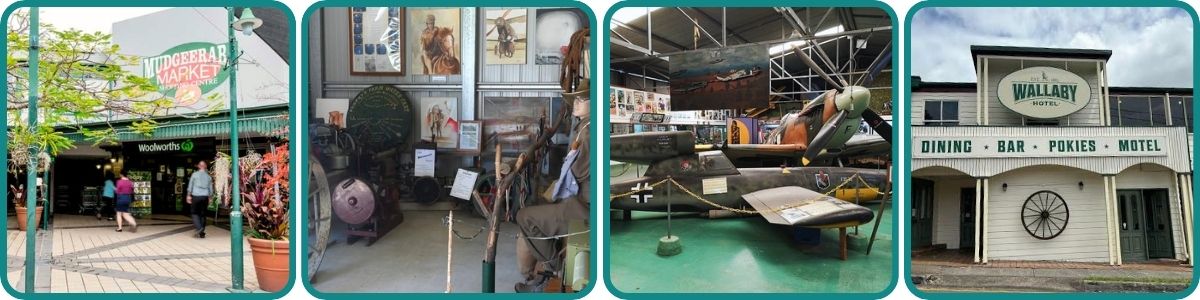
- The Mudgeeraba Showgrounds anchor the suburb’s identity, 13 acres held in trust for the City of Gold Coast and used year-round for community and commercial events well beyond show weekend.
- On John Rogers Road, the Gold Coast War Museum holds a working collection of military vehicles and memorabilia open to the public.
- The heritage-listed Wallaby Hotel (built 1884 as the Exchange Hotel) and the Old Post Office keep the railway-era streetscape intact rather than restored for tourists.
- Golfers have Tallai Country Golf, a nine-hole course just over the western boundary, and hikers use Mudgeeraba as the practical staging point for Springbrook National Park’s waterfalls and rainforest trails, a drive that coastal suburbs simply cannot offer as conveniently.
- Heritage/Art & Food Trails – see following section
- Museums and Paintball – see following section
The Heritage Walk
The self-guided Mudgeeraba Heritage Walk is Gold Coast City Council’s official trail through the village, and it’s a useful way to understand why the town looks the way it does. Pick up the trail map (downloadable from the council site) and you’ll be led past the buildings that made Mudgeeraba’s Local Heritage Register, each one a small chapter in the transition from timber settlement to railway town.
Start at the site of the old Mudgeeraba Railway Station. There’s no station left to see (it’s long gone), but the plaque in the park on the corner of Swan Lane and Mudgeeraba Road marks where the South Coast Railway line arrived in 1903, connecting Brisbane to Tweed Heads. That single addition reshaped the entire village, pulling the town centre away from its original site near the Uniting Church and rebuilding it around the new station instead. It’s a neat reminder that most “old towns” aren’t actually static: Mudgeeraba has already relocated itself once.
Across from where the station once stood, the Wallaby Hotel is still doing exactly what it was built to do in 1914: pulling a crowd. Originally the Mudgeeraba Exchange Hotel, it was commissioned by settler William Laver and built by his son-in-law. It picked up its current name in 1958 after a new ownership syndicate included local footballing legend “Wallaby” Bob McMaster, with nearby Wallaby Creek sealing the deal. More than a century on, descendants of the founding families still live in the area, and the pub remains the social hub it always was, minus the horse-drawn carts out front.
A short walk on, the tiny chapel at Mudgeeraba Uniting Church has stood on the same spot since 1890, making it the oldest surviving church on the Gold Coast. It started life as a Presbyterian church and doubled as the town’s school in its early years, standing in what was once the actual centre of Mudgeeraba before the railway pulled everything downhill.
Finish at the Old Post Office on Railway Street, a heritage-listed building with more career changes than most locals. Built in 1927 as the Shire of Nerang’s council chambers, it became the post office and telephone exchange under local storekeeper Jim Cuddihy from 1950. These days the council leases it out for community classes and functions, and it’s also home to Gold Coast Tech Space, a volunteer-run makerspace, so a building built for council paperwork now hosts kids learning to code. Mudgeeraba’s history is full of that kind of quiet reinvention.
The Mudgeeraba Food and Art Trail, which we’ll get to next, runs its own version of this walk too, so it’s worth reading alongside the council map if you want the fuller picture before you set off.
The Food and Art Trail
Here’s what separates Mudgeeraba from a lot of heritage towns that trade purely on nostalgia: it didn’t stop at preservation. The Mudgeeraba Food and Art Trail is the modern layer built on top of the old one, a self-guided route (with a downloadable trail booklet and map) linking cosy cafes, award-winning restaurants, artisan galleries, and farm-fresh producers across the village and surrounding hinterland.
Food-wise, the village punches well above its size. Long lunches, share-plate dinners under string lights, wood-fired pizza, and cocktail bars sit within an easy stroll of each other, all leaning into the timber-and-verandah aesthetic the old buildings already provide for free. On the art side, the trail connects to the Doyles Art Award, the Gold Coast’s premier art prize and exhibition, alongside a rotating cast of hinterland artists working in everything from wildlife painting to ceramics.
Time your visit around one of the recurring markets and the trail earns its name properly. The Mudgeeraba Village Markets take over the Memorial Hall on the second Sunday of every month with arts, crafts, and local makers, while the Laneway Market pops up three times a year (April, July, and November) for pre-loved fashion. Add in the annual Agricultural Show, complete with old-school woodchopping displays, and the Somerset Storyfest writers’ festival, and you start to see why Mudgeeraba treats its history as something lived in rather than roped off.
The Gold Coast Hinterland Heritage Museum
If the walking trail gives you the story, the Gold Coast Hinterland Heritage Museum gives you the substance. This is a volunteer-run, working museum on Mudgeeraba Road, opposite the soccer fields, built around a genuinely rare collection: entire relocated buildings rather than just artefacts behind glass. Okey House, a 1930s Mudgeeraba farmhouse, sits alongside Franklin House, a 1956 family home built from locally milled timber. The original Nerang Railway Station, built in 1889, was moved to the grounds in 2007. There’s also the Tallebudgera Police Station gaol building, a replica slab hut, a blacksmith’s shop, a milking shed, and the “Big Blokes Shed” stacked with pioneering machinery.
Inside, expect a school room set up as it would have been decades ago, an extensive camera and photographic equipment collection, and a saddlery and light horse military display for those with an interest in the region’s wartime history. It’s the kind of place where the volunteers running it genuinely know the stories behind each object, and guided tours are available by request.
The catch is the opening hours. The museum runs on Sundays only, 10am to 2pm (or by appointment for groups), so this is one to plan around rather than stumble into. Entry is $10 for adults, $5 for children, and $25 for a family pass, modest for the amount of hands-on history on offer.
Gold Coast War Museum

Tucked just off Springbrook Road, the Gold Coast War Museum is the kind of place that catches visitors off guard, a sprawling, slightly chaotic militaria complex that’s been running since 1975 and only twenty minutes from Surfers Paradise. This isn’t a slick, curated institution; it’s a genuinely eclectic private collection covering everything from the Boer War through to Vietnam and Afghanistan, packed with firearms, uniforms, tanks, planes, and enough memorabilia that regulars report doing three laps and still spotting things they’d missed. It sits alongside Skirmish Gold Coast, Australia’s original paintball field, and the Collector’s Armoury, which sells replica weapons and genuine militaria, so the whole complex leans hard into “hands-on” rather than “hands-off history.”
It consistently ranks as the top thing to do in Mudgeeraba, with visitors calling out the value for money (adult entry sits around $15) and the sheer density of the collection, particularly a well-regarded section on Australia’s involvement in Vietnam. It’s open Monday to Saturday 9am-4pm and Sunday 10:30am-2pm, closed public holidays, so unlike the Sunday-only Heritage Museum, this one’s easy to fit in on a regular day trip.
Skirmish

Skirmish Gold Coast shares the same complex off John Rogers Road as the War Museum and bills itself as the region’s original outdoor paintball field, running games seven days a week, rain, hail or shine, with sessions closed only on public holidays. The standard package (from around $49) covers a semi-auto paintball gun, full face mask, camo coveralls, and 100 paintballs, and each two-and-a-half-hour session runs three scenario games (capture the flag, tank attack, and buck hunt style rounds) across a field kitted out with real tanks, helicopters, forts, and a bamboo forest built for ambush shortcuts, with a break for a drink and reload in between. Reviews and write-ups consistently frame it as a group occasion rather than a solo visit, bucks and hens parties, birthdays, and corporate days out get the most mentions, with staff singled out repeatedly for being friendly and easy to deal with from the first phone call through to the novelty award presentations at the end. Bookings are essential and there’s no upfront deposit required, but note the age cutoff: all players must be 15 or over, so it’s one to save for teens and adults rather than a young family outing.
Local Events
The Mudgeeraba Agricultural Show is the suburb’s marquee annual event, traditionally held on the last weekend of June and running since 1928. The 95th show in June 2025 drew more than 21,000 people over two days for equestrian and woodchop programs, livestock judging, sideshow alley and fireworks. The 2026 show was cancelled due to persistent wet weather, and the Show Society has confirmed (as of August 2026) that the 96th show is now scheduled for 26 and 27 June 2027. Worth checking the Show Society’s site closer to the date, given the recent cancellation.
Weekly, the Mudgeeraba Farmers Markets run every Saturday morning at the Showgrounds, a genuine grocery run for locals rather than a tourist stall trail, and widely regarded as the oldest running farmers market on the Gold Coast. On a smaller scale, the Mudgeeraba Village Markets run on the second Sunday of every month at the Memorial Hall on Railway Street, focused on local art, craft and handmade goods rather than produce.
What Is It Like Living in Mudgeeraba?
Locals will tell you two things newcomers usually miss. First, “Mudgeeraba” on a real estate listing can mean anything from a townhouse a five-minute walk from Robina Station to a two-acre block a twenty-minute drive up Tallai Road, so the postcode covers genuinely different lifestyles at genuinely different price points. Second, despite the village charm, the suburb is not sleepy: Robina Town Centre, the Gold Coast’s largest shopping centre, is close enough that most residents treat it as their own high street rather than a special trip.
Transport
Robina train station sits right on Mudgeeraba’s boundary (a 4 to 10 minute walk from the closest streets, longer from the acreage blocks further out), putting the Gold Coast heavy-rail line to Brisbane within easy reach without a park-and-ride. Translink buses 748, 758 and 759 run through the suburb to Robina Town Centre and the station.
The State Government’s Gold Coast Transport Plan includes the GC Surfer, a metro-style bus service running frequently between Robina and Coolangatta via Burleigh Heads and the Gold Coast Airport, backed by priority intersection upgrades along the Gold Coast Highway and a new interchange at the airport. It replaces the previously proposed Stage 4 light rail extension to Coolangatta. The same plan includes a separate 15-minute Robina to Miami metro-style service improving access to Bond University, launching from right on Mudgeeraba’s doorstep. As of August 2026 the Department of Transport and Main Roads has not published a firm construction start or opening date for either service. For general Gold Coast public transport planning, see our public transport guide.
For drivers, Mudgeeraba has its own Pacific Motorway interchange, making it one of the more direct hinterland suburbs for a coastal commute rather than a winding hinterland drive.
Healthcare
Mudgeeraba has its own GPs, including Mudgeeraba Family Medical Centre (in the Bell Central Shopping Centre) and The MGP on Bell Place, both mixed-billing practices operating in the suburb for over a decade. For anything beyond general practice, Robina Hospital and the wider Robina Health Precinct are a short drive away, with Robina train station sitting directly opposite the hospital’s main entrance. Aged care is well represented locally too: Carinity Cedarbrook, a 96-suite facility, sits on Mudgeeraba Road itself, backing onto farmland next to the showground, with several more options a short drive away in Robina and Merrimac.
Schools and Childcare
Mudgeeraba State School and Mudgeeraba Creek State School cover primary schooling, and Robina State High School is the zoned government secondary school. Demand is real rather than a footnote: Mudgeeraba State School operates under a Department of Education-gazetted Enrolment Management Plan (updated August 2025) that caps total enrolment at 711 students and limits Prep intake to 125 students across five classes. The school’s own reporting (current as of December 2025) puts enrolment at 660 students, so it is running close to, but currently under, that ceiling, and out-of-catchment places remain restricted to protect capacity for in-catchment families. Families chasing a place should confirm current catchment status directly with the school rather than assume out-of-zone enrolment will be available.
Childcare supply is broad rather than tight: around 32 centres serve the Mudgeeraba area, including 19 long day care centres, at an average cost of roughly $110 a day and a “Meeting NQS” average rating, in line with the national benchmark. Several, including two Montessori-based centres, sit inside the suburb itself rather than requiring a drive to Robina.
Industry and Work Life
Locally, health care and social assistance, retail trade, education and construction are the biggest employers, reflecting the suburb’s own schools, medical centres and shopping precincts. A meaningful share of residents commute to Surfers Paradise and Southport for tourism, finance and professional services work, which the M1 interchange makes a manageable drive rather than a genuine hinterland trek. The proportion of professionals living locally grew markedly between the 2016 and 2021 Census counts, a shift that tracks with the suburb’s stronger-than-average price growth in recent years.
Shopping and Eating Out
The village strip on Railway Street and around Bell Place is where the cafes, bed-and-breakfasts and art and craft galleries sit, underpinned by that heritage streetscape. For groceries, Mudgeeraba Market Shopping Centre and the Bell Central centre cover Coles, Woolworths and Aldi between them, so a big weekly shop does not require a trip to Robina. The Mudgeeraba Farmers Markets, widely regarded as the oldest on the Gold Coast, run regularly and are as much a social fixture as a shopping trip for long-term locals. For a wider range of retail and dining, Robina Town Centre is a five to ten minute drive.
Parks and Natural Spaces
Hinterland Regional Park gives residents a genuine slice of bushland without leaving the suburb, useful for a short walk rather than a planned hike. Sid Bigg Park, home to Mudgeeraba Soccer Club, anchors weekend junior and senior sport and sits within walking distance of the village centre for families who want sport without a drive.
Realty Market
Mudgeeraba’s housing market has run hot through 2025 and into 2026. The median house price sat at $1,340,000 in the 12 months to April 2026, up 10.74% year-on-year, with a separate May 2026 snapshot putting the median closer to $1,375,000 (up 7.84%) across 182 sales, a sign of genuine, broad-based demand rather than a handful of outlier sales skewing the number. Units have moved even faster in percentage terms: a median of $927,750, up 18.77% in the same period, reflecting buyers priced out of houses looking for a foothold in the same school catchments and village amenity.
Stock is a mix of older Queenslander cottages, 1990s and 2000s brick-and-tile family homes, and acreage properties toward Tallai and Bonogin, plus a smaller but growing unit and townhouse segment near Robina Station aimed at commuters and downsizers. The rental market is tight: houses are commonly listed from $850 to $1,000 a week in 2026, with gross rental yields sitting in the 3.2% to 4% range, modest for investors chasing yield but consistent with an owner-occupier-heavy suburb where most buyers are not weighing up cap rates.
Our Honest Verdict
Mudgeeraba suits families and professionals who want a real train-line commute option, a genuine sense of place, and are willing to trade beach proximity for a heritage main street and (in the outer parts of the suburb) some land. It is likely to appeal most to buyers who value the school catchments and the village character enough to accept a car-dependent daily routine once you are off the main strip, and to established families who are not chasing a coastal postcode.
It is a less compelling option for anyone whose priority is walking to the beach, and it is less compelling for investors primarily focused on rental yield, given the entry price has run well ahead of rents over the past year. The genuine cross-shop is Tallai, immediately to the west: Tallai offers more land and a more exclusively acreage, higher-end market with a median age around 44, while Mudgeeraba offers the same school zones and hinterland gateway feel at a meaningfully lower entry price, plus the train station, the shops and the village strip that Tallai does not have. Buyers who want space above all else should look at Tallai; buyers who want walkable amenity alongside acreage-adjacent character should stay in Mudgeeraba.
Frequently Asked Questions
Is Mudgeeraba a good suburb for families?
Yes, with one caveat: Mudgeeraba State School’s enrolment cap means catchment placement is not guaranteed just because you live in the postcode, so families should confirm zoning for a specific address before buying rather than assuming it.
How far is Mudgeeraba from the beach?
Around 12km to Burleigh Heads, roughly a 15 to 20 minute drive depending on traffic on the M1 and Reedy Creek Road.
Can you get to Brisbane by train from Mudgeeraba?
Yes. Robina station, on the edge of the suburb, sits on the Gold Coast heavy-rail line with direct services toward Brisbane, making it one of the more practical hinterland suburbs for a rail commute.
Is Mudgeeraba all acreage blocks?
No. The postcode covers everything from village-centre cottages and townhouses near Robina Station to genuine half-acre and larger blocks further out toward Tallai and Bonogin, so buyers should be specific about which part of Mudgeeraba they mean.
References
- Australian Bureau of Statistics, 2021 Census QuickStats, Mudgeeraba (SAL32050), accessed 2026
- Your Investment Property magazine, Mudgeeraba QLD 4213 Suburb Profile (CoreLogic data), accessed April 2026
- Queensland Department of Education, Mudgeeraba State School Enrolment Management Plan, gazetted August 2025, enrolment figures updated December 2025
- Queensland Government, Gold Coast Health, Robina Hospital, accessed 2026
- Queensland Department of Transport and Main Roads, Gold Coast Transport Plan, accessed August 2026 (page last updated 14 August 2026)
- Carinity, Gold Coast Cedarbrook Aged Care, Mudgeeraba, accessed 2026
- City of Gold Coast, Mudgeeraba Village Local Area Plan (City Plan), accessed 2026
- City of Gold Coast, Mudgeeraba Investigation Area Study, accessed 2026
- Gold Coast City Libraries, Mudgeeraba local history collection, accessed 2026
Looking to compare Mudgeeraba against other Gold Coast suburbs? Browse our full guide to the Suburbs of the Gold Coast.